

Restraining Orders
Restraining orders back your boundaries with the power of the police and the courts. You can obtain a restraining order for conduct that may not amount to a crime. The Court can grant you a domestic violence restraining order (DVRO) or civil harassment restraining order (CHRO) that lasts up to 5 years.
Free, Easy Restraining Orders: Call the Police
The easiest way to get a restraining order is to call the police when you have been the victim of a crime. If police determined a domestic violence offense occurred, they will likely offer you an emergency protective order (EPO). These only last a few days, but if the district attorney files the case, you can request a stay-away order from the court while the case is pending, and if the person is convicted, the judge will grant you a restraining order. You will pay no attorney fees and will not have to fill out any paperwork on your own. This is the easiest way to obtain a long-term restraining order, but it only works in a small percentage of cases where the DA files a case and obtains a conviction. Most domestic violence 911 calls do not end in a conviction.
Steps to Get a Domestic Violence or Civil Harassment Restraining Order
If the criminal process is too slow or not responsive to you, or you don’t want to involve the police, you’ll need to file a request for a restraining order in the Family Court. It is possible to handle this yourself with guidance from the self-help center, but the forms can be confusing and presenting your evidence effectively in court is challenging. Particularly if kids are involved, or if the other person has an attorney, you should get professional help. The same general process applies if you need a DVRO or a civil harassment restraining order (CHRO), but the forms are different.
Step 1: Gather Evidence
Before completing any court forms, gather as much evidence as possible documenting the abuse or harassment.
For a Domestic Violence Restraining Order (DVRO), California law defines abuse broadly and includes conduct that destroys your mental or emotional calm—not just physical violence.
For a Civil Harassment Restraining Order (CHRO), evidence showing repeated harassment, threats, intimidation, stalking, or other disturbing behavior may support your request.
Helpful evidence may include:
- Statements from family members or friends who witnessed the abuse or whom you contacted afterward.
- Text messages containing threats or abusive communications.
- Call logs or text records showing repeated unwanted contact.
- Police reports from prior incidents.
- Photographs of injuries or property damage.
- Videos, screenshots, emails, or social media messages documenting the abuse.
Step 2: Complete the Forms
Once your evidence is organized, complete the forms requesting either a Domestic Violence Restraining Order (DVRO) or Civil Harassment Restraining Order (CHRO).
In addition to requesting a permanent restraining order, you will typically ask the judge to issue a Temporary Restraining Order (TRO) that remains in effect until your court hearing.
An attorney can often strengthen your request by preparing a detailed written declaration supported by organized exhibits that clearly explain your case.
Pro Tip #1: Attach a Declaration & Exhibits
Rather than trying to fit every detail into the court forms, write "Please see attached declaration" wherever the forms ask why you need protection.
Your declaration should describe each incident in numbered paragraphs and reference supporting evidence such as:
- Exhibit 1
- Exhibit 2
- Exhibit 3
Each exhibit should be separately numbered and include a cover page identifying the exhibit.
Pro Tip #2: Include Every Incident
It is generally better to include every significant incident of abuse from the beginning, even if some incidents seem minor.
If children witnessed the abuse, be sure to describe those incidents as well. Waiting until later in the case to mention important events may result in questions about why they were omitted from your original filing.
Pro Tip #3: Request That Notice Be Excused
If you fear the restrained person may react dangerously after learning about your request, ask the court to excuse advance notice so that service occurs only after the Temporary Restraining Order has been granted.
Step 3: File Your Papers & Serve the Other Party
After completing your restraining order packet, file it with the court.
The judge will review your paperwork and decide whether to issue a Temporary Restraining Order while scheduling a hearing on your request.
Once the judge signs the paperwork, the restrained person must be formally served.
Service can usually be completed by:
- The Sheriff's Department.
- A registered process server.
- Another qualified adult who is not involved in the case.
Step 4: Prepare for the Hearing
The court will schedule a hearing where both parties may present evidence and testimony.
If additional evidence is needed before trial, formal discovery tools may be available, including document requests and depositions.
An attorney will typically:
- Organize exhibits.
- Prepare written legal arguments.
- Develop a witness strategy.
- Present evidence and question witnesses at trial.
If you represent yourself, organize all exhibits carefully, number each exhibit, prepare a table of contents, and bring at least three complete copies of everything for the court and the opposing party.
Step 5: Final Orders, Custody & Attorney Fees
If the judge grants your restraining order, you will prepare the final order for the judge's signature and arrange for formal service on the restrained person.
If children are involved, a Domestic Violence Restraining Order may significantly affect custody rights. California law creates a presumption that awarding joint custody to the restrained parent is not in the child's best interests until that presumption has been overcome.
If you hired an attorney and successfully obtained a DVRO, the court is generally required to order the restrained party to reimburse reasonable attorney's fees and costs, subject to their ability to pay.
Attorney's fees may also be awarded in Civil Harassment Restraining Order cases under appropriate circumstances.
If you are unsure whether or not you need an attorney or if you have other questions, give us a call for a free consultation.
Defending Against Restraining Order Requests
If you have been served with a temporary restraining order and the other party has a lawyer, you should hire an attorney ASAP, unless you do not care if the other party obtains a long-term restraining order. Remember, restraining orders affect your gun rights and can show up on background checks. Most importantly, if you have kids with the other person, a DVRO will affect your custody situation.
If the judge has already granted a temporary restraining order, do not fear. You can still win the trial and defeat the long-term restraining order if the facts are on your side, particularly if the other party has been abusive to you.
The best defense to a DVRO is…a DVRO.
It is not uncommon for the more abusive partner in a relationship to get to court first and request a DVRO. Perhaps you both have tempers and sufficient evidence to convince a judge that the other person is abusive towards you. In this situation, if you are served with a temporary restraining order, you should immediately prepare your own request for a restraining order in addition to filing your response to the other person’s request for a restraining order.
Without filing your own DVRO request, at trial, the judge only has to decide if the other person has presented evidence showing it is more likely than not that you have done things to “destroy” the other party’s “mental and emotional calm.” If you file a DVRO request, however, the judge has to determine which one of you was the “primary aggressor” in the relationship, or whether one of you acted primarily in self defense. In “toxic” relationships, where both parties have dirt on each other, a trial on competing DVRO requests can end in a denial of both restraining order requests, or sometimes the person who sought a restraining order first ends up as the only restrained party. Rarely a judge will grant mutual restraining orders. You do not get the benefit of the judge having to identify the “primary aggressor” unless you request a DVRO.
Kids and DVRO’S
In nasty custody disputes, one parent will sometimes seek a DVRO without good reason as a means of getting immediate custody of the kids. This can be devastating not just for the restrained parent but for the children, who share a close bond with both parents, or perhaps only with the restrained parent. When the court finds that domestic violence has occurred in a relationship, either between the partners or against the children, Family Code section 3044 creates a presumption against joint custody for the perpetrator. To overcome this presumption, the perpetrator has to demonstrate that joint custody is in the children’s best interest.
This can be accomplished by:
- Completing domestic violence and parenting classes
- Complying with probation terms, if applicable
- Not violating the terms of the DVRO
- Not committing any additional domestic violence
If you have been served with a temporary restraining order, your child or children may be immediately removed from you, at least until the trial on the long-term DVRO.
It is critical you hire an attorney right away to restore your rights and to minimize the damage that can occur while you wait for the trial on the long-term restraining order. Ask your attorney whether filing a competing DVRO request would make sense in your situation. This can sometimes be the fastest way to get your kids back.


Her skills in depositions, trial work, and cross-examination are outstanding and she knows exactly how to elicit the right testimony. She fought for me during an especially difficult situation, where my ex was involved with his attorney — something that complicated the dynamics significantly.
Her balanced approach between litigation and settlement is rare and invaluable. Since my case was transferred to her, not only did I feel more protected legally, but my mental health significantly improved as well.
If you are looking for someone who will truly stand by you, advocate for truth, and handle even the most complex situations with skill and compassion, I can’t recommend Hali enough.


If you are unsure whether or not you need an attorney or if you have other questions, give us a call for a free consultation.
PROUDLY SERVING
Ventura County
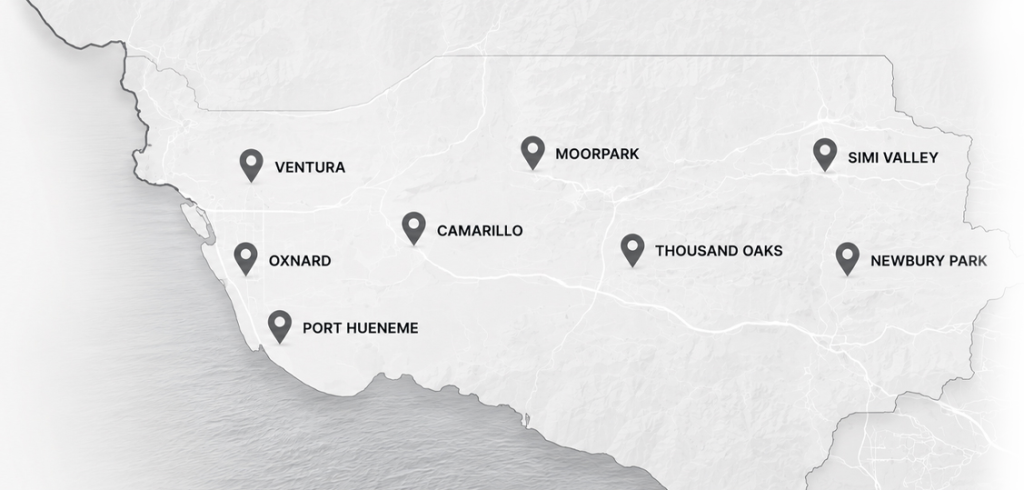
We proudly represent clients in every city and community across Ventura County.
About Restraining Orders in Ventura County
California has several types of restraining orders, each with different scope and consequences. A Domestic Violence Restraining Order (DVRO) is available under the Domestic Violence Prevention Act, Family Code Section 6203 (definition of abuse) and Section 6320 (specific prohibited conduct: harassing, stalking, threatening, attacking, contacting, disturbing the peace). A DVRO can include stay-away orders, no-contact orders, exclusion from the residence, custody and visitation orders, and firearm surrender under Section 6389 (mandatory turn-in within 24 hours of service). Civil Harassment Restraining Orders (CCP 527.6) cover people outside a domestic relationship. Workplace, elder abuse, and gun violence restraining orders are also available.
Ventura County DVRO requests start with a Request for Order (DV-100) and Temporary Restraining Order application at the courthouse. Emergency Protective Orders (EPOs) can be issued by law enforcement after-hours and last up to 7 days. Temporary Restraining Orders (TROs) last up to 25 days pending a full hearing where both sides testify. After the hearing, permanent orders can last up to 5 years (renewable). Violation is a criminal offense under Penal Code Section 273.6 and can result in arrest and prosecution.
Hali Ford represents petitioners seeking protection and respondents defending against DVROs and civil harassment orders. Because a DVRO can affect custody, firearm rights, immigration status, and professional licensing, both petitioning and responding require careful strategy. Related: family law, custody, domestic violence charges. Self-help: CA Courts DVRO self-help. Statute: Family Code Section 6203 on Justia.
Free consultation — 805-853-FREE or contact us.